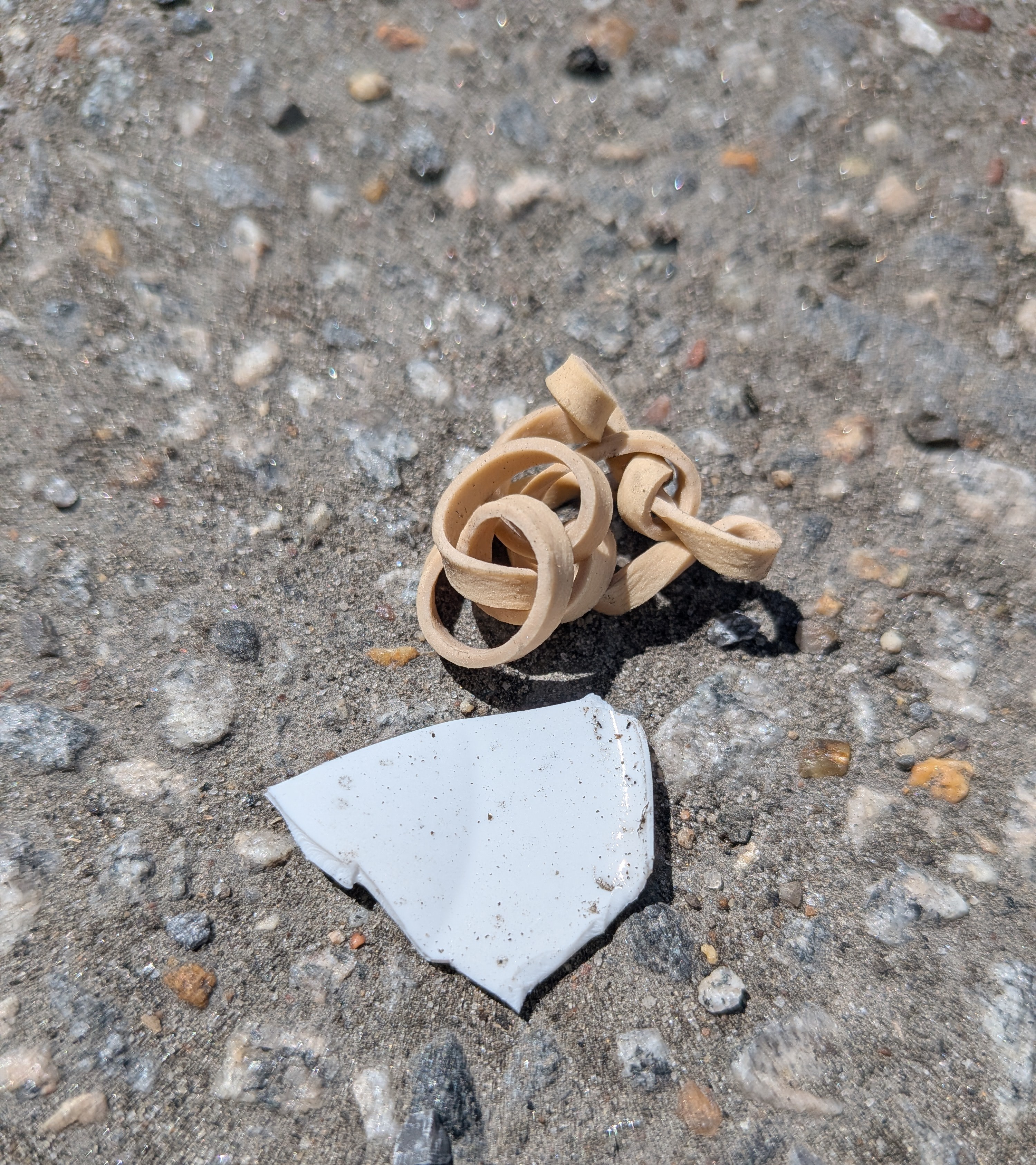
Geometric Connection Theory aims to describe the way that objects can remain next to each other under random conditions, when they are topologically isolated.
An example of objects that are connected by their topology would be a chain, where the links cannot be separated, or a jar with the lid glued on and a ball inside. The ball would be trapped inside the bottle.
Geometric connection theory provides different reasons that objects remain together (adjacent in space).
Classic Geometric Connection
Example 1: A ball is in a bottle with a thin neck. You could roll the bottle down a mountain, and the ball may remain in the bottle. You could hold the bottle perfectly upside down, and the ball would fall out.
Example 2: A ball is in a bottle with a very wide neck relative to the size of the ball, but the bottle is very large. If this configuration is floating in space, the ball may not find the opening any time soon, since the outside of the bottle is so large.
Force Field Connection
A bowl is on a table, and a ball is in the bowl. You may shake the table, and the ball may never roll out of the bowl.
A hook. A potted plant hanging from a hook attached to another hook may stay suspended, even though the hooks can easily be separated by a person.
Combinatorial Connection
A ball in maze. You could shake the maze a long time with the ball not falling out of the exit.
Charcoal log water filters. A contaminant particle drifts through the water and enters a pore in the charcoal. The network of pores has so many pores within pores, that there is a small chance that the contaminant particle will find its way out any time soon.
Tension (spring) Connection
Nail clipper, advanced symmetry in video
The connection quantification problem
Suppose we define the degree of connection as follows. We shake the objects or allow them to follow a continuous random walk (where they bounce off each other if their surfaces meet) and random continuous rotations until we see the distance between them grow as they drift away from each other. Because if the objects are not topologically connected, eventually if they move randomly they will fall apart. (notes that there may be exceptions, see for example random walks tend to return only in 1 or 2 dimensions, not in 3 or more)
Potential difficulty in quantifying the connection
Similar to Betrand's paradox, depending on how we define shaking or continuous random walk, connection strengths may have different values.
Questionable Axiom
If the donut and the hotdog are atoms of topology, then the cave and the stick are the atoms of geometric connection theory.
Single Object Self Connectivity (knot theoretic defense of above axiom)
Here is an example of an object, a loop knot, where different pieces of the object restrict movement of the other pieces of the object.